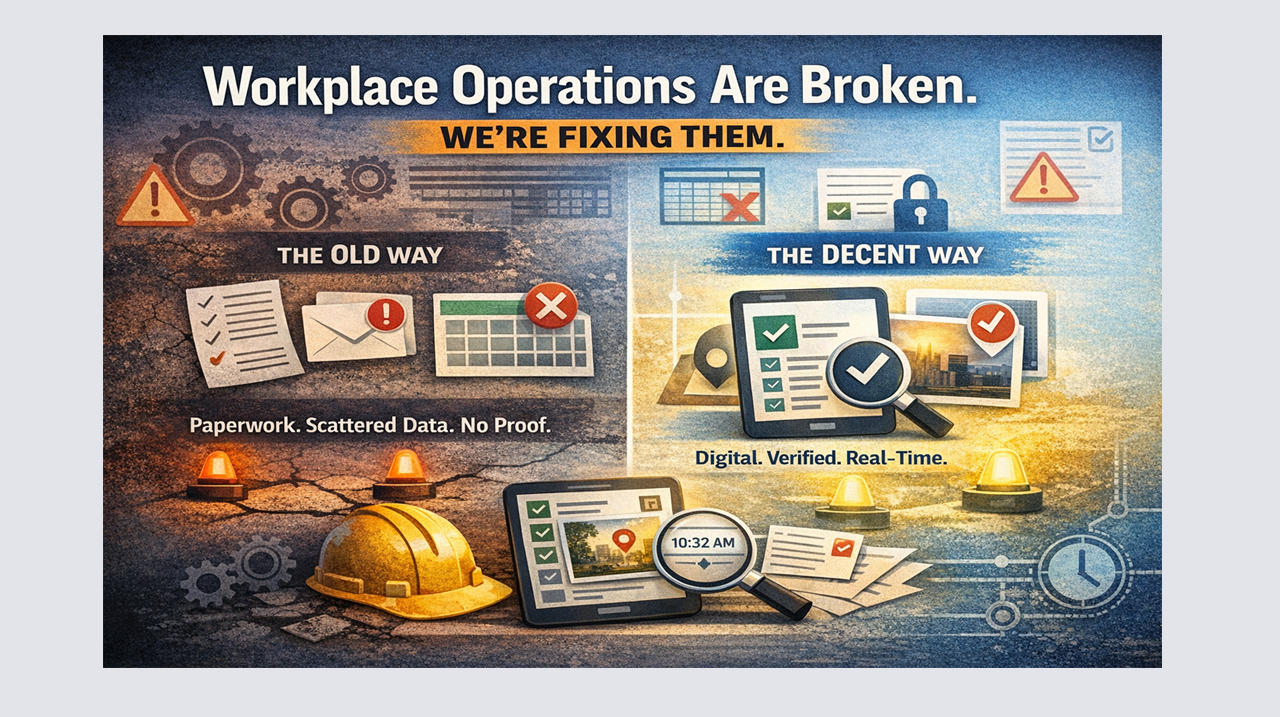
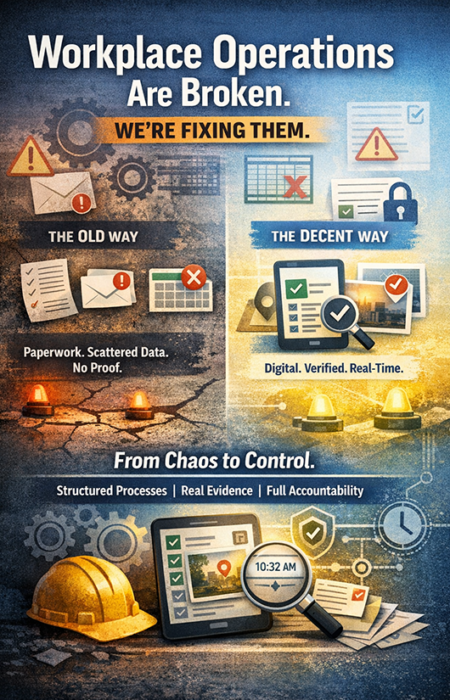
Workplace Operations Are Broken. We’re Fixing Them!

broken-operations
Introduction

We’ve spent enough time around real operations to know this: most workplace processes don’t fail because people don’t care.

They fail because the systems behind them were never designed for accountability at scale.

Across industries — construction, manufacturing, facilities management, logistics — inspections are still managed in spreadsheets, maintenance logs disappear into inboxes, tasks are marked complete without evidence, and when something goes wrong, teams scramble to reconstruct what happened after the fact.

This isn’t a people problem. It’s a systems problem!

And it’s costing organizations more than they realize.

Every organization relies on critical workplace processes to operate safely, efficiently, and responsibly.
From inspections and audits to asset checks, maintenance routines, and compliance workflows, these processes form the backbone of daily operations.

Yet in many industries, they remain fragmented, manual, and difficult to verify.

Spreadsheets, paper forms, disconnected tools, and siloed systems make it hard to ensure consistency, accountability, and trust — especially in environments where risk, regulation, and operational complexity are constant.

At Decent, we believe workplace processes should be transparent, verifiable, and easy to manage.
Not just to meet compliance requirements, but to help organizations operate better, safer, and with confidence.

Our mission is to modernize how workplace activities are monitored, recorded, and improved — by building a data-driven, decentralized platform that brings integrity and clarity to everyday operations.

from-chaos-to-control-550
The Cost of Poor Operational Visibility

Operational inefficiencies rarely appear as a single dramatic failure. They accumulate quietly — through missing documentation, delayed maintenance, unclear responsibilities, and inconsistent reporting.

The consequences, however, are measurable.

According to the International Labour Organization (ILO), nearly 2.9 million people die every year from work-related causes globally. Beyond the human tragedy, the economic burden of occupational injuries and diseases is estimated at nearly 4% of global GDP (ILO, 2023).

In the United Kingdom alone, workplace injuries and work-related ill health cost £20.7 billion annually (UK Health & Safety Executive, 2022/23). In the United States, OSHA estimates that businesses spend roughly $1 billion per week on serious, non-fatal workplace injuries through direct and indirect costs.

What’s striking is this: most organizations already have policies. They already have procedures. They already have compliance frameworks.

What they lack is operational truth in real time.

When inspections are backfilled, when evidence is uploaded days later, when records can be edited without traceability, the organization may appear compliant — but it is exposed.

The failure is rarely dramatic neglect. It is fragmentation.

The Illusion of Control

Spreadsheets create a comforting illusion of order. Shared folders feel structured. Email threads feel documented.

But none of these tools were designed to manage distributed, multi-site operations under regulatory scrutiny.

  • They do not enforce ownership.
  • They do not verify timestamps.
  • They do not protect record integrity.
  • They do not scale across contractors and rotating teams.

Research from McKinsey & Company shows that organizations digitizing core operational workflows can improve productivity by 20–30%. Yet many workplace environments still rely on what can only be described as digital paperwork — disconnected tools attempting to simulate operational systems.

The result is predictable: compliance becomes reactive, audits become stressful, and leadership decisions rely on incomplete visibility.

When teams expand, contractors are introduced, and regulators demand evidence rather than intention, “trust us” is no longer sufficient.

Organizations must be able to answer — immediately and confidently — who performed the work, when it happened, where it occurred, and what verifiable evidence exists.

If answering those questions requires searching inboxes or messaging platforms, operational control is an illusion.

What We Believe

We believe well-run workplaces don’t rely on heroics. They rely on systems.

Health & Safety, facilities, assets, compliance, and daily operations aren’t separate worlds. They overlap every day. Treating them as silos guarantees friction, blind spots, and finger-pointing.

Good operations are boring in the best way. Things get done. Problems surface early. Data tells the truth.

What Well-Run Operations Actually Look Like

High-performing workplaces do not rely on heroics. They rely on systems that reduce ambiguity.

In structured operational environments, responsibilities are embedded into workflows. Evidence is captured at the moment of execution. Records are protected from silent modification. Managers see performance across sites in real time.

Deloitte’s research into digital risk and control transformation indicates that organizations implementing structured digital controls can significantly reduce compliance risk exposure — in some studies by as much as 40%.

The defining feature of good operations is not excitement.

It is predictability.

Nothing surprises leadership because nothing is hidden. Tasks are completed transparently. Issues surface early. Data tells the truth without interpretation.

That is operational maturity.

Why Integrity of Records Matters

1. Editable Records Create Risk
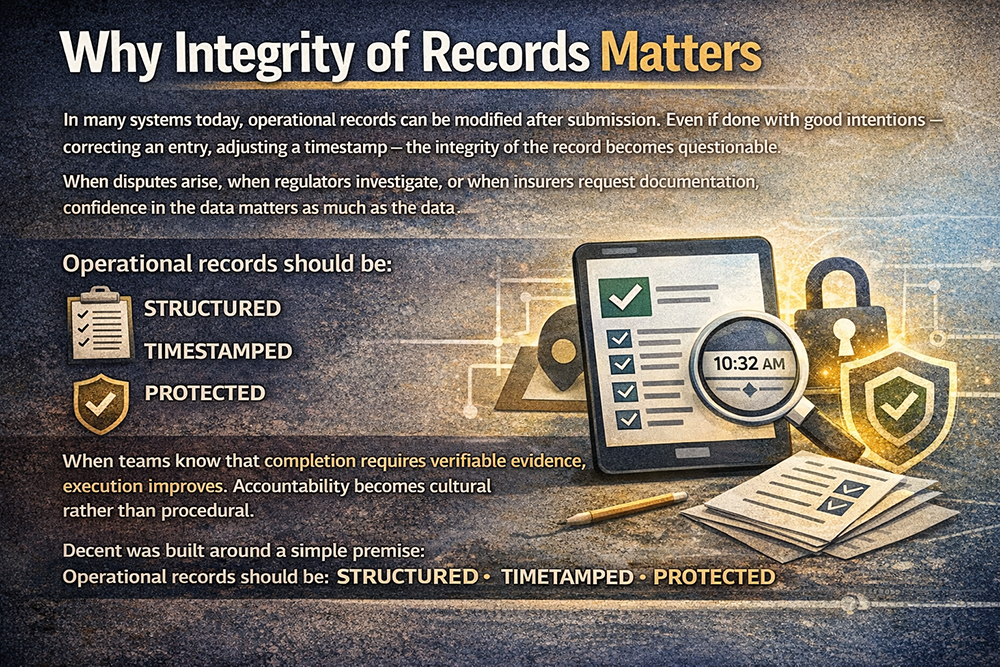
In many systems, operational records can be modified after submission. Even when changes are made with good intentions — correcting an entry or adjusting a timestamp — the integrity of the record becomes questionable.

2. Confidence Matters in Disputes
When disputes arise, regulators investigate, or insurers request documentation, confidence in the data matters as much as the data itself.

3. Structure Prevents Ambiguity
Operational records should be structured, clearly defined, and consistently captured inside the system — not scattered across emails or external files.

4. Timestamps Protect Accuracy
Work should be recorded at the moment of execution, with reliable timestamps that reflect when actions truly occurred.

5. Evidence Must Be Verifiable
Photos, structured forms, and real-time submissions ensure that completion is backed by proof — not memory or assumption.

6. Integrity Should Not Rely on Trust
Once recorded, an entry’s integrity should be protected. Records should not depend on goodwill or informal discipline to remain accurate.

7. Accountability Becomes Cultural
When teams know that completion requires verifiable evidence, execution improves. Accountability shifts from procedural enforcement to embedded culture.

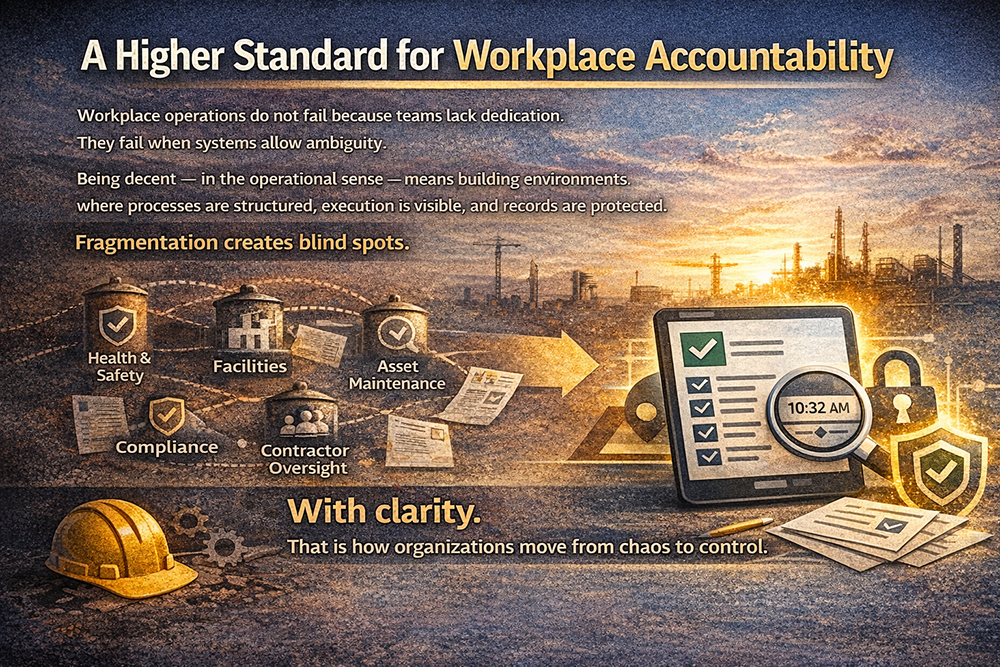
Breaking Down Silos

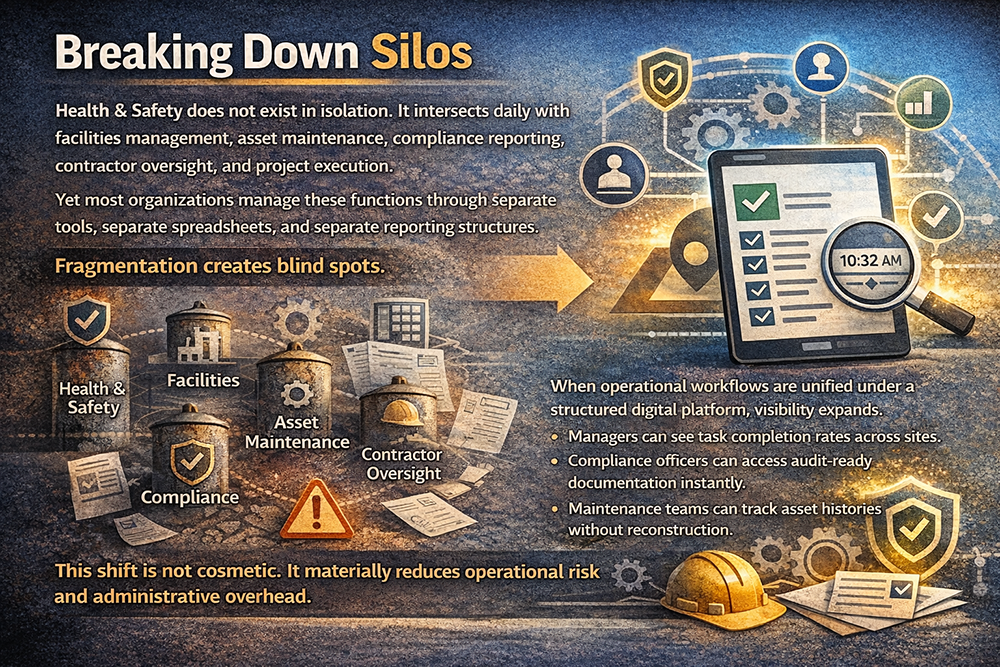
Health & Safety does not exist in isolation. It intersects daily with facilities management, asset maintenance, compliance reporting, contractor oversight, and project execution.

Yet most organizations manage these functions through separate tools, separate spreadsheets, and separate reporting structures.

Fragmentation creates blind spots.

When operational workflows are unified under a structured digital platform, visibility expands. Managers can see task completion rates across sites. Compliance officers can access audit-ready documentation instantly. Maintenance teams can track asset histories without reconstruction.

  • Audits stop feeling like investigations. They become confirmations.
  • This shift is not cosmetic. It materially reduces operational risk and administrative overhead.
The Financial Argument for Structured Operations

Beyond safety and compliance, there is a direct economic case for doing operations properly.

The U.S. National Safety Council has reported that organizations investing in proactive safety systems can see workplace incidents reduced by up to 50% over time. OSHA’s “Safety Pays” program consistently demonstrates that every dollar invested in effective safety programs can yield between $4 and $6 in return through reduced injury-related costs.

Improved operational visibility reduces downtime, strengthens regulatory standing, and can positively influence insurance outcomes. But perhaps more importantly, it reduces uncertainty.


Leadership no longer relies on weekly summary emails to understand site performance. Data becomes continuous rather than episodic.

Clarity replaces assumption.

From Reactive to Controlled

The transition from fragmented processes to structured operational systems is not about technology for its own sake.

It is about moving from reactive management to controlled execution.

Instead of chasing updates, managers observe progress. Instead of reconstructing events after incidents, they review verified histories. Instead of preparing for audits under pressure, they operate in a state of readiness.

This is what modern workplace operations should look like.

Decent – A Higher Standard for Accountability

Workplace operations do not fail because teams lack dedication.

They fail when systems allow ambiguity.

Being Decent — in the operational sense — means building environments where processes are structured, execution is visible, and records are protected.

Every task.
Every inspection.
Every site.

With clarity.

That is how organizations move from chaos to control.

Decent Marketing
Cart (0 items)

Create your account